The most consequential problems of the energy transition cannot be solved with software alone. The founders who competed for the Stanford Impact Founder Award for Ecopreneurship (EcoSIF) this year already know this—and the companies they’re building are proof.
In April, I had the privilege of returning to my alma mater to be one of the judges of this award, the winners of which were recently announced. As one impressive student after another presented plans to build a company that would take on a challenge of import, I was struck by their sense of purpose and bravery. These were not naïve students wielding solutions looking for a problem—they had crafted their ideas based on learnings from their own lived experiences and reframed the problems they sought to solve.
When we started Valo Ventures in 2018, my partners and I believed that profit and purpose make powerful motivators when combined. We had a theory that the biggest problems of our day would attract the brightest minds, and I am pleased to report that the EcoSIF program showed that to be the case. Stanford students from the School of Engineering, the Graduate School of Business and the Doerr School of Sustainability have bold ambitions to build big companies that also address the toughest issues resulting from climate change.
We had a theory that the biggest problems of our day would attract the brightest minds, and I am pleased to report that the EcoSIF program showed that to be the case.
The award winners are not shying away from doing hard things, such as building solutions in industries like energy and maritime that are slow to change or adopt new technologies. Importantly, they personally lived the problems they chose to solve before they started their companies, clearly establishing “founder-problem fit.” Subhankar Mihir Seth saw his consulting clients struggle to find low-carbon ways to make steel and wondered whether there was a way to make low-carbon coal, leading him to start Climitra. The founder of Mar.OS, Renata de Marsillac, was part of the Brazil IMO delegation and wondered how the organization would be able to implement the proposed new low-carbon fuel regulations. Will Salisbury, founder of Latis Materials, worked in the composites industry and wondered if there was a way to develop low-cost carbon fiber so that more industries could benefit from lightweighting. Francis Appiah, who started Cetera Energy, had operating experience in oil and gas and then lithium mining, and wondered if there was a way to extract lithium from all that waste water the oil majors produce for each barrel of oil.
As a result of their hands-on experience, they knew that being a whiz kid with a great technical solution would not be enough—patience is required to affect change in these industries. But this is where the impact happens, so the rewards are worth that patience. At Valo, we knew that working closely with large asset owners in the real world was critical, and we have done so from the beginning with the corporates we’ve enrolled as both Limited Partners and thought partners. Our corporate LPs have helped us know where to look for durable solutions, and also sharpened our saws when we invest. Importantly, they have also provided helpful feedback and commercial relationships with our portfolio companies, challenging them to elevate their solutions and find true product-market fit.
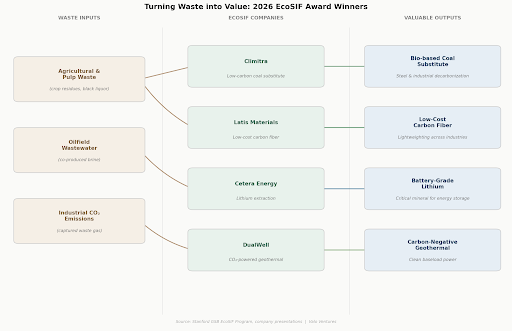
It’s important to recognize that to solve the problems they set out to address, the Stanford entrepreneurs are often building tangible solutions rather than just code. Well before the “HALO” trade was popularized, at Valo we saw that while software may have been “eating the world,” we would also need physical solutions to address the knottiest problems. One of our investment themes is Energy Expansion, which has been expressed via investments in advanced geothermal solutions with XGS Energy and small modular nuclear with Steady Energy. A second theme is Physical AI, such as our investments in Simbe Robotics and PlanetiQ. And the third theme is Advanced Materials, such as Clever Carnivore and Biosqueeze. These are companies that make atoms, not just bits, because that is often what is needed to have the desired impact. So we celebrate the EcoSIF winners who are producing things like bio-based coal, low-cost carbon fiber, lithium and carbon negative geothermal power.

Entrepreneurs are also increasingly reframing waste as a source of value. From our founding in 2018, Valo has invested in circular solutions. We backed companies such as Boston Materials, which upcycles carbon fiber scrap into a high-performance material now sought after by the semiconductor industry to address thermal management challenges, and Novoloop, which upcycles non-recyclable plastic waste into a drop-in replacement for polyurethane. We also invested in RoadRunner Recycling to help increase recycling rates while saving customers money. But so often, we had to define what we meant by circular solutions.
I was therefore thrilled to see so many examples of waste-to-value in the EcoSIF awardees. Waste from agriculture and pulp and paper production become feedstock to produce a low-carbon coal substitute for Subhankar at Climitra and low-cost carbon fiber for Will at Latis Materials. Wastewater from the oil and gas industry becomes a source of lithium to power batteries in the hands of Francis at Cetera Energy. And Kyle Lottinville’s DualWell uses waste CO2 from industry to power geothermal wells. With supply chain disruptions, geopolitical considerations and critical material shortages to grapple with, this reframing of waste is becoming more essential than ever.
I am so impressed by the fellowship and award winners, and look forward to following their progress as they leave The Farm and enter the world. Keep an eye on this group, as I know they will accomplish meaningful things!